J'aime Paris

I love Paris. I visited Paris and London on my first Europe trip almost 15 years ago. I've been back a few times since (including backpacking with Paul) and still manage to keep the love affair strong.

Of course there's awful things about Paris - the overpriced and touristy food, the reek of the underground system and the fear of pickpockets more so than any other place I've been.

But then, you stand under the Eiffel Tower for the hundreth time and still wonder how a big hunk of metal could be so delicate and lovely.
 
Or you sit at a classical music concert in the beautiful stained glass chapel of Saint Chappelle and feel like it must be a dream, the setting is so unreal.

 
Or you find yourself simply wandering the streets and stumble upon the hidden beauty of Jardins des Luxbembourgs, the perfect spot on a sunny day to pop up a bottle of champagne and people watch.

 
Or even just talking a stroll by the Louvre (whether or not you go in to glance around it's treasures) and catching the sunlight or moonlight at the perfect moment to mask everything in a glow.


Then, as you wander back to your hotel in the ecclectic Montmarte neighborhood, you'll smile as you discover the Love Wall or even Amelie's favourite diner, and know that your Paris love affair will continue despite the people, smells and your poor French skills. So, you celebrate with a glass of wine, perhaps a crepe and bask in the glow of l'amore.


Under the Desert Stars

As I planned out our trip in Jordan, I originally slotted for us to be in Aquaba. With diving & snorkeling, I thought it would be a perfect quick stop on our way to Petra.

Then, as I read more and asked around, I heard more and more about Wadi Rum.  Since we already swam the Red Sea in Egypt, I decided that it was a special opportunity and so we booked up a tent in a bedouin camp.

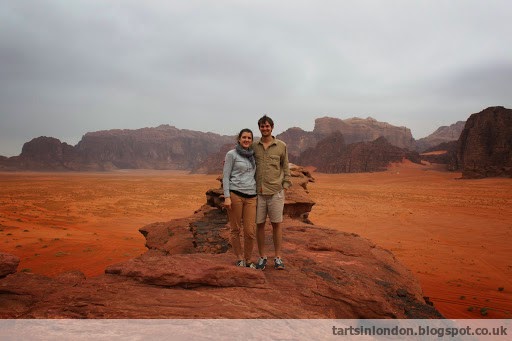
What made it the area so appealing? It's most famed for it's ties to T.E. Lawrence (of Lawrence of Arabia), as he travelled through the area during the Arab Revolt. But while many may visit for that reason, all will come away remembering by its nick name of Valley of the Moon Rock; the name is certainly earned by it's unique rock landscape among the dunes. It was made a protected area in 1998, meaning that there are no large hotels nearby, so if you want to stay, you'll want to arrange to stay at one of the bedouin campsites in advance.

Since we were arriving from the Dead Sea, we had a half day on either side of one evening in Wadi Rum. You drive up through the gates, purchase your ticket while trying to avoid being heckled by the people selling goods & services, then drive on into the village to meet your guide. We found our man, left our car and hopped into the 4x4 to ride off into the desert.

 
The guide was a fantastic idea; even if you had the proper car to drive in the sand, likely you'd get lost among the endless sand, dunes, mountains and more sand. With a map in hand, I could only figure out landmarks after we'd passed them, there's no way I could have found my way through the desert without roads or any sign posts. Our guide was a local bedouin who knew the area by heart, making it seem easy and we spent our first afternoon driving through the white desert part of the park.

 
While the sites you see are similar throughout the park, there's still a lot to admire in the unusual rock formations. The rocks themselves look almost like a melting birthday cake, flat on the tops and sides, with colours dripping down the sides, like icing that has sat too long into the sun.
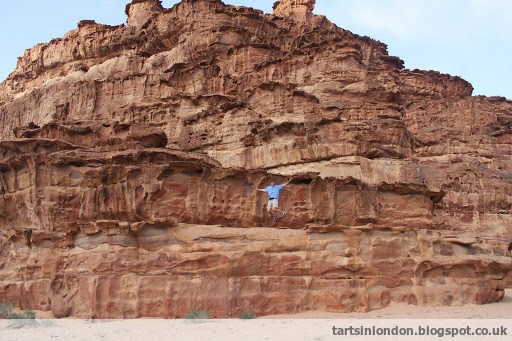
Teeny Paul puts those giant rocks into perspective


The landscape is covered with rock bridges, formed by the sand and winds forces on the rock over thousands of years. It's a hugely popular place for rock climbers, but dangerous as well as some of the rocks can be soft and give way if you don't know what you're doing.

 
We spent the afternoon driving, exploring and hiking, finally ending up to hope to catch the sun set, only to see sand sweeping across the plain instead. Unfortunately the wind made our plan of camping under the stars a lot less enjoyable. We ended up trying it anyways, but it made for a noisy night without too many stars for us to view.

Despite a restless night, we woke up the next day ready to go. We were visiting the Rock Bridge of Um Fruth, one of the more famous rock bridges. We didn't have time to climb the Rock Bridge of Burdah, so we had to be content with just one. It's not really a hike but not really a climb, rather a scramble. We were told to take off our shoes, scurry up and wait our turn to cross over the bridge.  To finish off our morning, we drove past the Seven Pillars, the thousand year old paintings of camels and finished up at Lawrence's Spring.

 
If you aren't a hiker, this may not be the place for you - the landscape is stunning, but you may not find it enjoyable to sit in a very very bumpy car all day. If you do hike, I thought one full day was enough time for us, but others we met at the camp had stayed longer and still seemed to be enjoying it. The camps are rudimentary, with stuffed mattresses and local traditional blankets, or if you went our route, blankets to sleep on the rocks. Some camps may have toilets & showers, others you may find yourself roughing it, so decide what you feel comfortable with!


Lowest Point on Earth

I spent a lot of time planning out our Jordan itinerary, trying to figure out the best driving routes since we were being our own tour guides, finding the best timing and making sure we were in the right place at the right time. Usually, I'm more laid back, go with the flow, but with so much to see in Jordan in such a short period of time I wanted to make sure I didn't miss anything.

We planned to spend our first night in one of the Dead Sea resorts, getting 24 hours there. I figured this would be enough, but I was wrong.

Access to the Dead Sea can be either through public beaches with an entrance fee, or private resorts that border on the Dead Sea itself. We went with the latter and stayed at the Jordan Valley Marriott Resort and Spa; it is definitely a resort, with pools, restaurants and bars for everyone's tastes. We got there just around check-in time and immediately got into our suits and headed down to the "beaches" of the Dead Sea. The area down by the sea was under construction when we were at the hotel, so it was noisier than I would have liked with out many good places to set your things, but they had a few changing rooms and access to the sea, so everyone just got on with it. They provide you with little rubber slippers to wear (which were a bit of a flashback to the jellies of my childhood), which supposedly help reduce your chances of slipping. 


When we got down to the water, we noticed a few big clay jars filled with mud that everyone was slathering themselves in. We decided, hey, what the heck, let's join them, so we grabbed clunks of the goopy mud and slathered it on ourselves, head to toe.

 
After we felt satisfied that every body part was caked, we went into the water. While everyone says you just float, I was still surprised. I REALLY floated. I stood there, let myself fall backwards, and my face didn't even get wet I was so buoyant. It was an odd feeling, laying there, facing the sun, floating along. You can't really even paddle yourself since it's hard to get your body parts to stay under the water. There's no splashing around (since the salt water would burn your eyes, trust me), simply relaxing. As time passed, all the mud washed off me, leaving my skin feeling soft, so I got out, rinsed off, re-applied and did it all over again. 

 
Later on, when I was reaching prune stages of water exposure, we decided to head back up to the resort to relax. We found a bar with perfect views of the sunset, enjoyed a cocktail, then later in the evening a bit of hookah. After a relaxing dinner, we called it a night.

 
Then, the next day, we woke up and did it all over again. We wanted to get down to the Dead Sea early to give us plenty of time to clean-up before we checked out at noon. It was even more tranquil getting there before the crowds and taking in the serenity of the water without people in it.

Just like that, our time in the Dead Sea was up. Despite all my planning, I found myself thinking about throwing plants to the wind and spending more time at this mysterious place. In hindsight, I'd planned it all backwards. We should have gone out to do all our hiking in Petra and the Wadi Rum before coming to the Dead Sea to relax, but it still gave us a great first taste to what Jordan has to offer.


Driving Jordan

Lately I’ve been looking for new types of experiences in my travel. I know I sound horribly spoiled when I say I’m a bit over cathedrals and ruins, but the truth is I’m really looking for things now that give me a new perspective and a better insight into the local culture, not just something I’ve done before.  Part of this is trying to get an authentic feel for the places I go, away from the tourist packed streets, shops and restaurants, and into places that you discover on your own or through locals, so I’ve been focused on independent travel. I’ve found when you’re in a tour (especially depending on the tour or country) you stop in places that were built to serve the giant buses of tourists that stop in some of the most popular destinations of the world.

Jordan was one of my first true experiments with this outside of Europe, because not only were we not with a group, but we decided to drive ourselves. We figure, if we can drive in Istanbul, we can drive most places?


So, after picking up our car in Amman, we started our explorations.  While our first overnight stay was at the Dead Sea, we had planned a few other pit stops on the way where a car would be necessary.

First was Mount Nebo – this is where Moses was said to stand out and see the promised land of Israel. You can see the vast expanse of desert around the mountain, dotted with lakes (or pools) and even the Dead Sea in the edge of your view. There is a church on site which supposedly has beautiful mosaics, but it was closed when we visited, so we snapped some shots, took in the expanse of it all, then started our drive towards the Jordan River.

 
The road weaved back and forth on the desert plain, taking you from a mount to one of the lowest areas in the world. You passed bedouin tents with fires out front and can imagine a lively scene at night with music, dancing and laughter around the camp fire. In some places, you may have been stopped by a shepherd moving his sheep across to the other side of the road, in no particular hurry. It highlights the way that many locals live and the bedouin history of the area.

The Jordan River was easy to find after joining the main road, thanks to many signs in English that dotted the highway. Along with the signs, we found tons of people selling fruits, vegetables and who knows what else along the road to those who can be enticed to stop. You can't drive yourself through the sites at the River Jordan, so we waited for the bus and crammed ourselves in along with everyone else, giving me flashbacks to my days boarding the buses in Istanbul.

 
We walked around the site with the guide, who I think was mainly there to make sure no one wandered over into Israel. The main place to see is the site where historians think Jesus was baptised. Nowadays, it's not on the river, just a sad pool of water that doesn't connect to anything else and is not fit for anyone to dip as much as a toe in. There are the relics of a church nearby that were likely built to commemorate the importance of the site. 


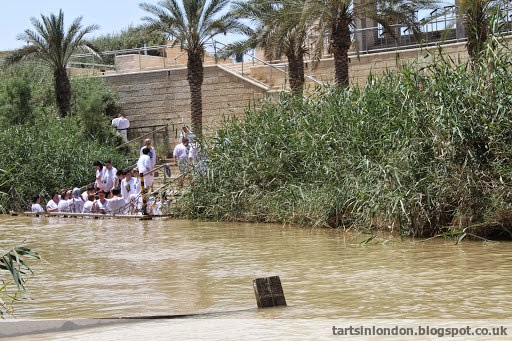
After that, we followed the path down to the river itself. It's a slow moving river, flanked on either side by rushes, and so narrow that you can see the Israel side a stones throw away (really, less than 50 metres away). The Jordan side seemed more relaxed, with people watching, talking quietly among themselves and sitting to take in the tranquility.  The Israel side is full of people in white robes, immersing themselves in the water, either to clean themselves or have themselves baptised by others. We sat for some time, just watching - it may have 5 minutes, 30 minutes, I can't recall now, but just taking in the nature and scene around us.

 
Then it was back to the crowded bus, back to our hot car, and back on the road. As we drove, we saw the way of life in Jordan. More street vendors selling fruits, waters and knick knacks. More shepherds along with their gaggly looking sheep, and even some with camels, sat beside the road, perhaps waiting to spit on the next passerby. I was happy to be in control, making our own pace and picking our own stops, but for now, we decided to keep on going and headed further down into Jordan.


Remembering D-Day

As I mentioned, I'm trying to work back through my backlog of travels to fill you in. I'm not quite done telling my story of Jordan, but with the 70th anniversary of D-Day today, I decided to skip ahead and fill you in on a part of our France trip instead.

We went early in May to Paris and Normandy with Paul's brother and his wife; it's so easy to get to from London via the Eurostar, then we rented a car to drive out to the coast.

Our first day and evening in Normandy was spent around some of the important sites of World War II. We started off in Bayeux, famed for it's tapestry which dates back to the 11th century showing the Norman conquest of England. After viewing the tapestry, we wandered the old streets on a quiet Sunday morning, grabbing some coffee and crepes and settling in to watch time pass us by in typical French fashion.  The slow paced morning put is in the right, somber mood for the afternoon.

We had arranged a tour of the Normandy beaches through a tour company for the remainder of the day. While I'm all for independent travel, I decided this was a case where I wanted an expert telling me the significance and history of what we were looking at.  

 
After a brief start at Gold Beach, we headed over to Omaha Beach. It's now almost a resort town despite it's haunting history. A merry-go-round overlooks the beaches with tourists and families dipping their toes in the water, which 70 years ago to this day were filled by an army and everything that comes along with it.  They had build floating docks after the landings to help bring all the tanks and supplies onto the beach and we could still see some evidence of them to this day; even more can be seen with the right tide.  

You can see the edge of the artifical harbour out to the right
Next was a stop to the American Cemetery; unlike it's neighboring Omaha Beach, this is haunting. The design of the cemetery is beautiful, filled with trees, a large memorial upfront, and thousands of crosses and star of Davids commemorating those who died. Walking among those crosses help give a picture of the magnitude of loss in the war and their hometowns put into perspective how close to home this was for many people. While the beaches themselves were historical, this was an emotional experience.

 
To end our tour of the beaches, we went to Pointe du Hoc (to go to Utah beach, you'll need a full day). This was a strategic position from either side of the war, as the artillery there could be used to fire upon the beaches to the East (Omaha) and the west (Utah). To take control of this location, a battalion of US Army Rangers was sent. Before they would be able to reach the target, they had to scale cliffs of 100 feet.  Amazingly, despite the odds, they were successful, but it was a long battle and they were cut off from the rest of the army for 60 hours, meaning a lot of casualties.

One of the cliffs they climbed, erroded over time

In order to put the Rangers in the best position, there was shells fired from a boat in advance to help disarm the enemy, or at least have them give a bit of retreat. Because of this, the land is pockmarked, with deep dips in the land creating almost a lunar landscape. Unlike other parts of the area where the holes have slowly filled in over time, these remain, only now filled with grasses and flowers, the changes in depth the only reminder of what they had previously been.

 
On the walk back to the car, there were stories telling us the history of the brave Rangers who went on such a dangerous mission. These little personal stories help to paint a clearer picture of the war - they weren't just soldiers, but people like us including doctors, teachers, parents.

 
If visiting Normandy, I would highly recommend taking a tour of the area and the guide you have is key. We were lucky enough to have someone who had studied history and was a guide part time while he finished his book (about World War II), so he brought the history to life and answered every question we had. There's also lots of literature out that that can give you a better detailed background of the war. We were recommended D-Day which includes photos and videos from the war as well.

 One of the guns at Pointe du Hoc

Thank you to all the Veterans who fought for peace.

"They fight not for the lust of conquest. They fight to end conquest. They fight to liberate." 
President Franklin D. Roosevelt, 6 June 1944