Showing posts with label Turkey. Show all posts

Batman in Turkey

In honor of last weekend's release of the Batman movie (at least in Turkey), I thought it was time to share a little bit about Turkey's own Batman.

A few months ago, Paul went on a trip for work to Diyarbakır in Southeast Turkey. While he was there, the local employees wanted to show Paul some of the history of the area and took him to the Hasankeyf Caves in the Batman region.


The city was built thousands of years ago along the Tigris River. And of course anything along the Tigris you know has to have one heck of a history. It is thought to be one of the longest consistently inhabited cities (probably right behind Damascus), with a history of longer than 10,000 years. Apparently the city was even mentioned in the Mari tablets, dating back to 1800 BC. Hasankeyf was also an important stop on the Silk Road, showing its importance at the time, even if it is a little mentioned place today.


While there are tons of important sites to visit here in one of the best preserved Medieval towns in Turkey (such as the El Rizk Mosque, Hasankeyf Castle and Zeynel Bey Mausoleum), what Paul visited were the caves. Similar to the caves in Cappadocia, there are thousands here with a picturesque view over the Tigris. Cave living is still an odd concept to me, but it must have had its appeal way back in the day for so many different people to have adopted it.


The big controversy about this area right now? No, it's not that the city is sueing the producers of Batman, although that's a true story.

It's the possible extinction of the city. People are trying to get a dam built in this very region and it threatens this historic city. While the government has offered to move some of the historic monuments (something along the line of 30) out of the city, historians are still up in arms about it. It's thousands of years of history potentially down the dam and underwater. Hopefully it turns out with a happy ending so that the history can be shared with the world for many more years to come.

Paragliding in Ölüdeniz

When we were talking about our trip to Ölüdeniz, everyone decided they were in for paragliding.  At first, I decided I wouldn't do it. I mean, as the saying goes, if all your friends jump off a cliff, are you going to jump too?

Family and friends know I am terrified of heights. Also extreme, dangerous activities, but mostly heights. When we were in Switzerland, Paul wanted to go canyoning. I vetoed and instead we went biking through the Alps (just regular old bikes, no fancy, speed increasing motors for us).

Then I thought about it some more. Read up on it online and researched the sport. I was wavering, thinking maybe, just maybe I could jump off the cliff.

Finally, Paul made a bet with me - he said he didn't think I would do it. The wager? House cleaning. You can see he was pretty positive that I would NOT jump off a cliff, or as he says it was reverse psychology at work.

And like my usual self, I had to prove him wrong.

We had a reservation to jump on our last afternoon in Ölüdeniz. After our morning trip to Fethiye, we headed back for our paragliding appointment. On the drive up to the mountain, I was anxious. The ground looked so far! The fall off the edge of the road seemed precipitous, ignoring the fact it wasn't a cliff!

Then, after a few tears and watching some others go off first, the fear vanished. I was strapped in to my guide, who was strapped into our parachute. He told me to run and I did. Straight off the edge of a cliff.

What we hoped wasn't our last picture together

Yes, you literally run off the edge. Luckily, air picks you up
before you actually reach the edge, so there's no drop

Once you are up in the air, it seems like nothing. So we're 2,000 meters off the ground? No biggie. My guide put some music on mostly to entertain himself, but it also helped me to continue to feel at ease. I could literally sit back and enjoy the views.

Burak and I enjoying the ride

Hey Paul! Right before they started
doing acrobatics. I wasn't quite
that brave, yet

It is worth it alone for the views - the beaches are gorgeous from the ground, but from above you can really see the blue of the water, the contrast of the mountains and beaches. Depending on the wind and weather, you can be up in the air for hours if you find the right thermals (pockets of hot air).

Belcekiz Beach

Blue Lagoon
Then, just like that, we were losing altitude and flying over the city for our landing. The time literally flew by and I was wishing for just a little more time up in the air above paradise.

We're alive!

2012 Trip #10 - Ölüdeniz, Turkey

This vacation paradise was actually brought to me by my dad. When we decided to move to Turkey, we gave him a book about Turkey so that he could read up on it and plan out a visit to come see us. One of the photos in the book was from Ölüdeniz and he insisted that we/he had to visit.

Unfortunately, he didn't get to make a stop there on their visit (although we did visit the beautiful pools at Pamukkale), but Paul and I were excited to go this past weekend so he could live vicariously through us and because I always love going to the beach.

The area is known for it's beautiful beaches and picturesque landscape. You have the blue beaches surrounded by the majestic mountains, giving you the best of both worlds to enjoy.  We didn't waste much time getting to the beach and went straight away to the water after we arrived at the hotel.  Ölüdeniz translates to "Dead Sea" and you can understand why as soon as you hit the water. It is so salty that you simply float - no need to paddle.


Our first true day, we didn't break a stride and continued with our explorations of the beaches surrounding Ölüdeniz. We checked out Camel's Beach, the nearby Springs (which contrary to our boat guides joke are NOT hot), St. Nick's Island and the famous Blue Lagoon.  The water is clear blue, and great for swimming, even if the beaches are a bit rocky for my taste. My favorite had to be St. Nick's island. Here you can see the remains of the monestary which was the original resting place of St. Nicholas (or who we now know as Santa Clause) - from where our boat anchored, we swam 5 minutes and were able to stand in the ruins of what was once the monastery and see old stones underwater as well.

The shoreline of St. Nicholas' island. You can see some of
monastery ruins on the hillside.

A view of the water and a couple of the "humps" that give
Camel beach it's name

One of the things that I had seen in books and been very interested in viewing was the Lycian tombs. After viewing the tomb at the British Museum in London, I was even more anxious to view them in their natural habitat. Luckily, in Fethiye, a neighboring town to Ölüdeniz, is the start of the Lycian Way. This was my chance to see these famous tombs! I was going to see them, gosh darn it, even if it meant waking up early which was not my vacation preference.

The first stop on our drive towards Fethiye was at Kayaköy, which I had not heard of before our drive. This town, established by Greek Christians in the 18th century, was abandoned at the start of the 20th century. It's eerie compared to ruins like Troy and Ephesus, because with houses scattered all over the hillside, it's almost as if the entire city is intact (with the exception of the roofs). 

The ghost houses at Kayaköy
After our pit stop in Kayaköy , we made it to the Amynthas Rock Tombs on the outskirts of Fethiye. This particular tomb dates back to the 4th century B.C and was made for Amynthas, son of Hemmapias. While there isn't much to see inside, its worth the 5 TL entrance fee to go into the "park" and climb up the steps to the tomb. Here is the only place you can get an idea of the true size of this memorial. 

Amynthas Rock Tombs - this was
definitely a photo op, not because
I needed to catch my breath...

 
Quick History:
- This area was originally part of the area controlled by Lycians in the 1200-500 BC period.  Lycia's regions are now modern day Antalya and Mugla in Southern Turkey on the Aegean coast.
- Later, Lycia was incorporated as a province into the Roman Empire. After that, it fell under Byzantine rule and down the line to modern day Turkey.
-Oludeniz is one of the most photographed beaches in the Mediterranean.
- BabadaÄŸ Mountain, which offers a great take off point for the many paragliders, was called Mount Cragus in ancient times.

What to See:
- The Rock Tombs in Fethiye. If you have more time, check out the larger tombs in Dalyan.
- Views from Above: this area is one of the most popular for paragliding and for good reason. Make sure you find a reputable company which a good safety record.
- Blue Lagoon: this famous beach is great for swimming and people watching. It's a short walk away from the main part of the city.
- Butterfly Valley: this is another famous beach, but a little bit more difficult to get to. You can either take a somewhat gruelling trek (from what I've heard) or reach it via boat.

Getting Around:
- If you fly into the Ölüdeniz/Fethiye area, you will be coming through the Dalaman Airport. It is about a 45 minute drive to Fethiye and 1 hr 15 minute drive to Ölüdeniz. You can take the city bus into Fethiye from here and then another bus into Ölüdeniz, or most hotels can set-up a private transfer for you in advance.
- To get between Ölüdeniz and Fethiye, there is a dolmus that comes every 10-30 minutes for 4TL. This drops you off at the city bus terminal.

Kirkpinar Oil Wresting Festival

Back before we even moved to Turkey, I had read about the oil wresting festivals and decided I wanted to go.

Not because I wanted to see men rubbed down in oil. Not because I wanted to go to Edirne (although that desire changed after moving to Istanbul). Not even because I like wrestling.

The fun in it to me was the absurdity of it.  Men wrestling in olive oil. So weird.

This weekend was my chance to go. It was the 651st Annual Kirkpinar Oil Wrestling Festival, meaning that they have been doing this continuously since 1361. Paul's aunts and cousin were in town and it was the perfect chance to show them something unique to Turkey. We rented the car, bought the tickets, re-bought the tickets once we lost them and finally made it into the stadium.

It wasn't what I expected, to be honest. I think the excitement for most spectators comes from supporting your city or region's wrestlers, whom you cheer on throughout the day. There were 20 matches going on at a time. Without having a wrestler to support, it was almost sensory overload. There was always a match to watch, always something happening and always a bit of confusion on our end at the rules of it all.


Men waiting to be a part of the competition watching the many
groups currently wrestling. Since we went on Saturday we
missed the championship and presentation of the golden belt
What most struck me though was the history and tradition of the whole spectacle. While nothing is incredibly interesting to a casual observer about the wrestling itself, it is amazing to think that 651 years ago, men were doing almost exactly the same thing. Wrestling each other, lathered up in olive oil and their buffalo leather pants, in the grass, with the band playing in the background and spectators cheering them on.  Today, it still has the feeling of a county fair with local booths set up outside, men hanging out drinking tea and chatting.

Men getting oiled up for the matches.
They use only local olive oil
We were fortunate enough to run into one of the (hundreds) of wrestlers over dinner in Edirne. We got a lot of our questions answered about the rules and background of the festival, which made it even more intriguing. Children start training for this around age 7. If you become good enough, you are sponsored by the city and it basically becomes your job. You train the whole year leading up to this and then it could be over in 5 minutes. Needless to say, emotions run high, and you can see the disappointment in many men who are on the losing side of the match.

After dinner, I had one required stop to make before heading out of Edirne. After visiting a lot of mosques in Istanbul, I have become fascinated with the story of Mimar Sinan. He was one of the most prolific builders under Süleyman the Magnificent and built or supervised the construction of more than 475 buildings. The Selimiye Mosque in Edirne is said to be his masterpiece. All you can do upon entering is stare up - such beatiful domes and so many little nooks and crannies in the ceiling with wonderful paintings.


Curious to check out the wrestling festival? It's an easy and beautiful two hour drive from Istanbul. Find dates and more information here.

2012 Trip #8 - Cappadocia, Turkey

When Paul read to me from the guided horse tour brochure that Cappadocia meant "Land of the Beautiful Horses," I called BS on it. I mean, that had to be a marketing gimmick if I ever heard one, right?

I stand corrected - a few tour guides later and for correctly answering the question of 'what does Cappadocia mean' to win an onyx egg, I have been humbled.

This last weekend, Paul, his parents and I ventured to the land of the beautiful horses.

We stayed in Göreme which is a great starting out point to get around the region. I thought 2.5 days would be enough for exploring, but as our last day wound down, I found myself wishing for more time to explore even more.


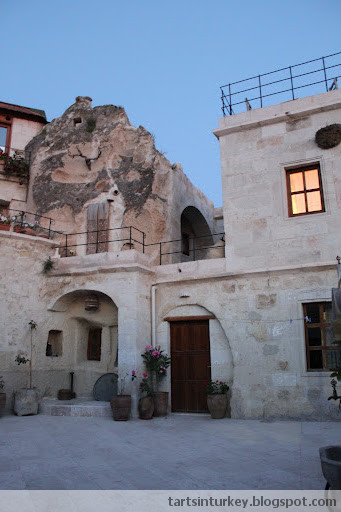
 Our "cave" hotel. It really was built into a cave, but most of the times the rooms are built outside of the cave with only certain parts of the hotel inside

 View of the fairy chimneys from our room

 The best way I found to see the most of the city, and perhaps the most frightening, is a hot air balloon ride. If you are not scared of heights, no fears. Even if you are scared of heights (like me), have no fears! I felt fine (almost) the whole time and we had smooth sailing.  We did the one hour tour and floated along some of the valleys, although I wish we could have seen even more.


After a nap, because waking up at 4:30 am is always too early, we set out to explore more of the city. We strolled through Göreme up to the Göreme Open Air Museum. The museum is full of caves that were used a churches, kitchens, living areas and more during the Byzantine period. It is different from many churches you see with frescoes painted on plaster put up on the rocks and the earlier period paintings are sometimes just rudimentary red paintings.
Göreme Open Air Musem
Fresco inside the open air museum


On day 2, we decided to venture outside of Göreme and visited some areas to the south of the city.

First were the Underground Cities of Derinkuyu - the deepest underground city. We went down 8 stories, but there were even more which have since collapsed or are a part of the 90% of the city that aren't available to the public.  Personally, I don't know if I could live in a cave at all, much less for 3 months, so props to them.

People were tiny. Or Paul is large.

This tunnel was something like 4 km long and linked up to another underground city

Next, we trekked through the Ihlara Gorge and visited St. Daniel's Church there. When I say trekk, I mean we really hiked through by the river for 3-4 KM.

According to our guide, this is the second largest canyon after the Grand Canyon. According to our research, the Grand Canyon is the second largest canyon and this one does not rank. So, always trust your tour guide.


View from the inside of the St. Daniel's valley located in the gorge

Finally, we ended up at Selime Monastery. According to the guide, the producers of Star Wars wanted to film here, but weren't allowed. I have to say this is my favorite stop of the trip. We were given free reign (or as much as you can have in 25 minutes) to wander around the caves, climb up to rooms that are less frequented and snap away to my hearts desire.

Walking up to Selime Monastery

Church inside the Selime Monastery

On our last day, I wanted to explore the famous Love Valley with the famous fairy chimneys. We started up the steep hike over the hill to get down into the valley and received a ride on the back of the truck of some friendly locals.  After depositing us near a path, we thought we were lucky and happily trotted down the trail. Who knows how many wrong turns, streams, ropes and 2 hours later, we finally came out near where we were supposed to hike. While we missed the magnificent Love Valley, we certainly got our exercise in for the day and still enjoyed some majestic landscape.

 View from the top of the valley

Pretty view of the valley looking up - all those pushes were scratchy.


 Quick History:
- Cappadocia is actually a region, not a city, in central Turkey. It is famous for its unusual rock formations that were created in the region which was triangled between 3 volcanoes and eroded over time to form what they are today.
- It is thought that the earliest settlers founded what is now Kayseri around 2000 BC.
- The region has had quite a few changes in control - first the Hittites, Persians, Romans, Byzantines, Seljuks, and finally the Ottomans.
- There is a lot of Christian history in the area - first during the Roman period with Christians hiding from persecution in the caves, then during the Byzantine period. There are churches everywhere as evidence of this.

What to See:
- Hot Air Balloon Ride: hands down the best part of the trip. It can be pricey, but it is worth it to have a reputable operator. Usually your hotel can arrange this for you.
-  Göreme Open Air Museum: a short walk from the town of Göreme, this is a must see. The Apple Church, Buckle Church and Dark church were some of the best preserved churches. The extra entry for the Dark Church is worth it (no pictures though).
- Zemi (Love) Valley: walk through the fairy chimneys (this is what we tried to do but missed)
- Underground Cities: there are several different underground cities, but these are difficult to reach with public transportation, so look into a tour or car rental options.

2012 Trip #7 - Bodrum, Turkey

Remember that time when I kept hoping it would stop being cold and start warming up? Let me go back to that time and recall my wish. It has finally warmed up here in Istanbul - everyday last week was reminiscent of Texas, but without the luxury of central A.C. everywhere. And, with everyone cranking up their A.C.'s, we've lost power in our neighborhood a few times.

We decided that this was the perfect weekend to escape the heat and head towards the water in Bodrum. The city is a lot like the smaller cities we have visited in Greece - lots of tourists, foreigners and beautiful water. 

Unlike our usual activity filled getaways, we were relaxed vacationers. The weekend consisted of basically lounging around by the water, whether it was on a boat, by the pool, or the deck. We hired a boat to go out to other bays, we snorkeled, had lunch and drinks on the boat, sunbathed and then did some more snorkeling, then more sunbathing. You don't even need to paddle here, you are so buoyant in the water you can just lay back and float by. 

We did take one night to go into the city for dinner and drinks. The city itself is charming too - lots of places to stroll with a view of the water, some interesting little shops and restaurants. Other than that, my experience with the city itself was limited. I didn't even try to get myself out to the castle! Another time, another trip.


 The "beach" - like most other places in the Mediterranean, it isn't very sandy beaches, but the water is beautiful

 Our ride for the day

Soaking up some sun on the boat


 Ships in the Bodrum harbor

 Shopping in Bodrum - the canopy of vines overhead makes it feel like its indoors almost

Quick History
- Bodrum used to be called Halicarnassus of Caria in ancient times. The city housed the Mausoleum of Mausolus, one of the seven wonders of the Ancient World.
- The Father of History, Herodotus, was from Halicarnassus.
- The first castle in the town is thought to have been built in 1100 BC, although St Peter's Castle was built upon its remains.

What to see - well, like I said, we saw nothing. BUT these are suggestions from others with us who had visited before.

- St Peter's Castle
- Museum of Underwater Archeology
- The water: rent a boat, jet ski, paddle boat, or simply float in the water.

2012 Trip #6 - Pamukkale, Turkey

We have another set of visitors this week - my parents! I have to say I have been amazed and grateful at the number of people who have taken the time to come visit us here in Turkey. I enjoy getting to be a tour guide to my new city and a lot of times, other places around Turkey.

My parents decided they wanted to take a quick excursion out of Istanbul with us and I decided it was about time that we got to visit Pamukkale. I had never heard of it before we decided to move to Turkey, but as soon as I saw the pictures, I knew I had to visit.

I feel like every trip has some kind of disaster to report. The airlines lost your luggage, you were delayed 3 hours, you couldn't find that hamburger that you desperately wanted at 10 am. This trip, however, went off without a hitch. We showed up at the airport, found the bus, which dropped us off in Denizli at the sketchy mini-bus, which dropped us directly off at the hotel. The hotel staff were wonderful, helpful and made a delicious kofte. We took the shuttle to the site, we walked around, we walked home and caught our flight back. Biggest disaster? A little sunburn.  I hope this is not a sign from the travel gods that my next trip will be a disaster.

We were only in Pamukkale one night/day which was enough to see everything in the grounds, although you may want more time if you are checking out some of the other ruins outside of the city.

The whole area you want to see is found in one park. We started off at the South Entrance and walked up to the Hierapolis first. 

 Theater of Hierapolis - it seats 12,000 people and the stage is still well preserved today. According to signs around the theater, they also built in some type of pool to allow for aquatic performances.


Martyrion of Saint Philip -  this is the place that the Apostle Philip was killed and his tomb was located here.


Frontinus Street - the street was 14 meters wide and the main artery of the city


 On your way back down you get your first close up glimpse of some of the travertines.


Next we decided to cool off from our walk in the hot morning with a quick dip in the Antique Pool. Not only was the water a wonderful, tepid 36 degrees Celsius, but you are swimming among marble columns and ruins, and the water is supposed to have healing powers. Perhaps it was the part of the water that had something to do with radioactive material? (Yes, they actually put this tidbit in the brochure).


 Warning! Apparently when people put bathing suits on, they like to pose. 
A Lot. We saw all kinds of fantastic posing, including this guy here.


Finally, we made our way back to the North exit by walking down the travertines. I don't think any words are needed to describe them and even the pictures don't do them justice!


 Courtesy of my dad and his 5 am jet lag trip to the travertines


 Courtesy of my dad and his 5 am jet lag trip to the travertines


Okay, well if all the cool kids are doing it.... Pose session!


Quick History
- Pamukkale translates to Cotton Castle in Turkish.
- In the 2nd century B.C., the kings of Pergamon established the thermal spa of Hierapolis.
- Philip the Apostle  was crucified here by Domitian around 87.
- The thermal pools are a lovely 35 degrees Celsius and are thought to have healing powers.
- The travertines are formed when calcium carbonate is deposited (after some technical scientific stuff happens) and it hardens into the travertine.
- Significant damage was done to the site due to tourism; once the site was made a World Heritage Site in 1988, many measures were put in place to help preserve the travertines for future generations

What to see
- Hierapolis: top sites are the Theater, St Philip Martyrion (this one is the furthest away but worth the hike; you may even have it all to yourself), and Frontinus Gate. If you get to the site early enough, you should be able to get a map with your ticket.
- Antique Pool: this costs an extra 30 TL to swim in the pool. If you just want to get a few snapshots of the pool itself and keep yourself dry, you can come in, sit, and have a drink or two.
- Travertines: the park is open 24 hours a day; the best time to get there though is early morning. You can get the sun coming up over the terraces before the light starts blinding you with its reflection and get the terraces much more to yourself than later in the day. You do have to walk without shoes on the travertines to help preserve them, but you have lots of opportunities to stop and wade in the pools on the way down. If you have sensitive feet, bring some extra socks to slip on for the walk.